

Description
The modification involved acoustic measurements, subsequent simulation, and a new design for the passive crossover. Emphasis was placed on achieving a balanced frequency response, both on-axis and off-axis.
This was combined with acoustic alignment at the listening position—since a balanced frequency response alone does not guarantee a coherent overall presentation that approaches the performance of a single-driver (full-range) design.
Given that the original drivers could not be replaced and the design had to rely on the manufacturer’s existing components, this was a challenging process. The resulting performance of the B&W 685 S2 speakers is balanced, composed, and musical, ensuring a fatigue-free listening experience even during extended sessions.
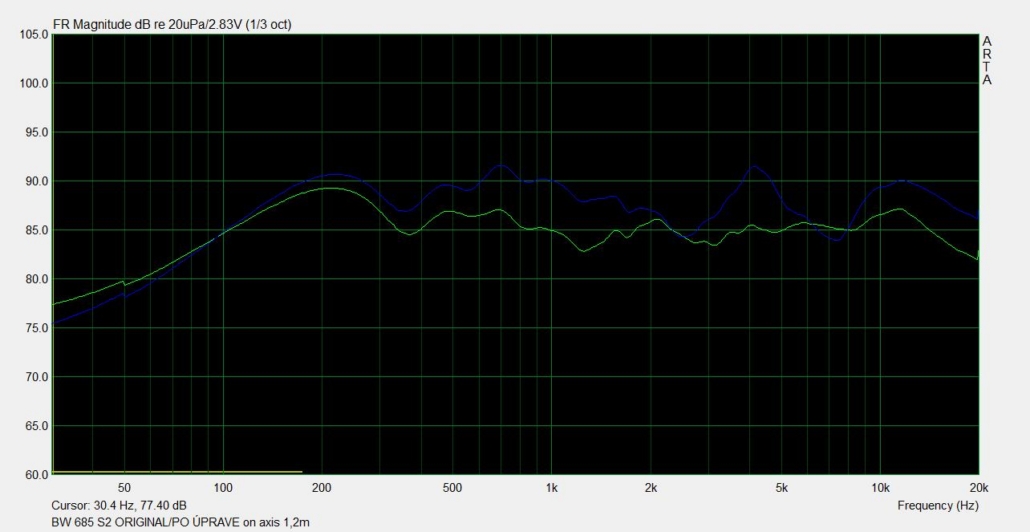
The measurements are valid from 300 Hz upwards; they were taken at a distance of 1.2 meters, on-axis with the tweeter, in a standard room environment. The first graph shows a direct comparison of the on-axis frequency response in the original state (blue curve) and after the modification (yellow-green curve). In the original configuration, there is a noticeable elevation in the 600 Hz – 1 kHz range, as well as a distinct peak around 4.5 kHz. The new response is significantly more linear, with the peak at 4.5 kHz suppressed and a balanced profile extending up to the highest frequencies.
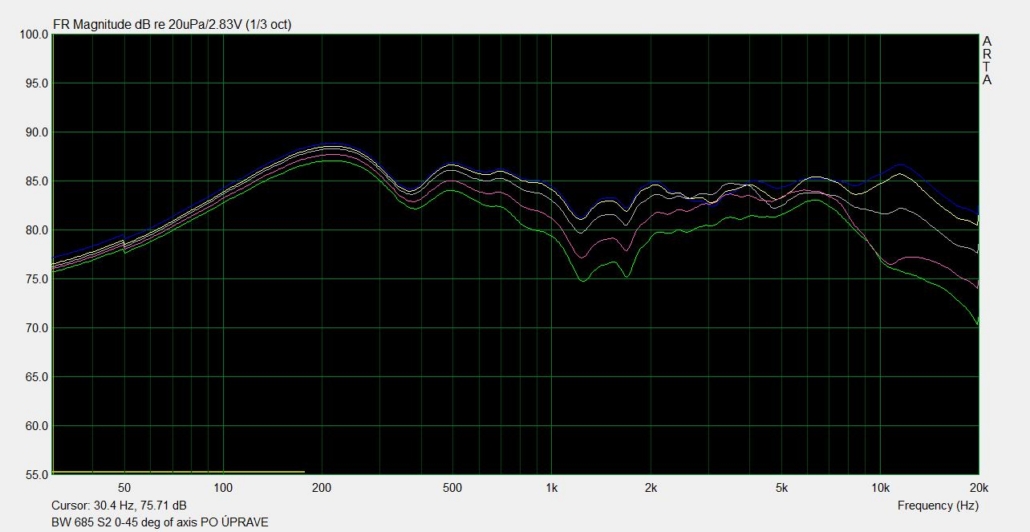
The subsequent graphs display the horizontal directional characteristics (off-axis measurements). The original configuration (0–15°) exhibited significant unevenness in the 1 kHz to 15 kHz range, with peaks at 4.5 kHz and 12–15 kHz. A series of measurements taken after the modifications (0–45°) shows that, even at greater off-axis angles, the roll-off remains natural and smooth.
Although a slight dip is visible in the 1.2 kHz to 1.8 kHz range (caused by the inherent characteristics of the mid-bass driver itself), the transition between the mid-bass driver and the tweeter is smooth, with no sharp spikes. The tweeter was not tasked with reproducing lower frequencies, in order to prevent distortion and excessive mechanical excursion.
Customer review.
Initially, the low end sounded tinny.
When compared directly to the similar 684 S2 model, the high frequencies were fine, but the bass lacked fullness.
Furthermore, the soundstage, dynamics, and sense of space felt stifled and lifeless—as if the speakers were covered by a blanket.
After the modifications, I was finally able to set everything up.
The modification was a success; I’m really enjoying the sound.
I even had to dial back the bass a bit.
There was more than enough of it, even though I’m using silver-plated QED Signature Revelation and QED Reference Audio 40i cables.
I’d even say the sound is punchier and more focused than that of the 684 S2 floorstanders.
I’m very satisfied.
Thanks again for the excellent work.