
YAMAHA DSP A1
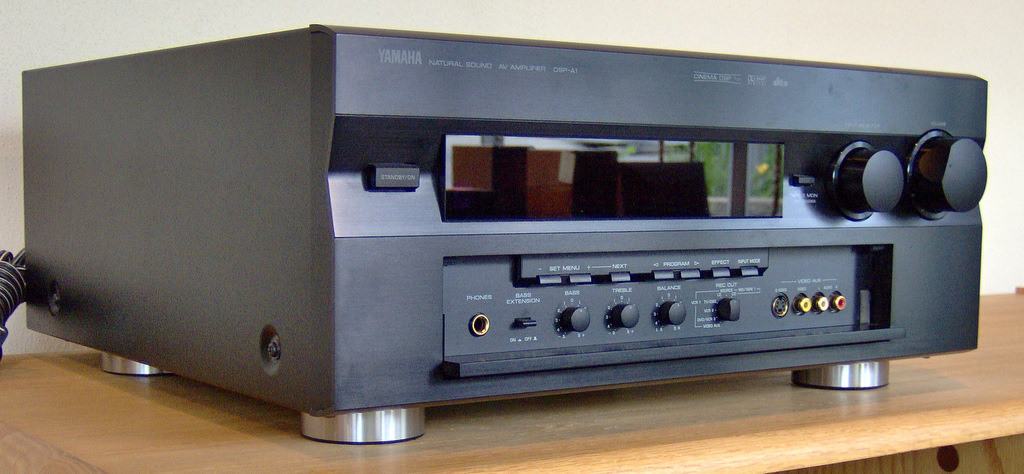
Audio Performance /Owner’s Observations/
First of all, I took plenty of time to evaluate the sound performance, listening to a wide variety of material. I’ve had the amplifier at home for about two months since the aforementioned modifications were made.
I tested it exclusively in stereo mode, as I haven’t connected my home theater system yet. I’ll add more details once I get the home theater set up…
My current source is a Denon DVD-1940 acting as a transport—meaning the signal is sent via digital coax to the amplifier’s internal converters. Of course, I also tested the standard connection using the DVD player’s own converters. For the impatient among you, I can say right away that I barely recognized my amplifier; the improvement is immediately audible, regardless of the music genre.
I should note that the following lines reflect my subjective opinion, though two other people—who know (or rather, heard) how the system sounded before—agree with my assessment.
Right off the bat, I can state that the amplifier has achieved stability across the entire frequency range and gained greater resolution. I had been warned that these modifications would shift the amplifier toward a neutral profile—one that stops “inventing” details or “coloring” the sound. I can certainly confirm this; I discovered that some CDs became unlistenable due to the demands they place on the playback system—but let’s start from the beginning. Starting with the bass: it was already decent before, but now it has gained distinct definition—gone is that mindless, cinematic boominess; the bass now has a sense of progression and is far better controlled than before. The midrange is cleaner, but the most significant improvement is in the highs; they have definitely lost their harshness, and the amplifier no longer “colors” them. I can comfortably listen at relatively high volumes, and the experience is worlds apart from before. Here is exactly what happens: as you turn up the volume, there is no sense of strain or aggression in the sound—you simply perceive pure music. It isn’t just noise; you experience a full-bodied sound where the reproduction shifts to highlight details, and the audio envelops you completely.
Regarding the soundstage, for the first time I can say I witnessed something almost unbelievable—you know that feeling where the speakers seem to vanish and the whole room comes alive with sound, extending to the wall, the table, and so on? Of course, it depends heavily on the quality of the recording. It wasn’t just the left-right imaging that improved, but the front-to-back depth as well—again, depending on the recording. Naturally, I’m discovering new sounds in familiar tracks, and the whole experience feels different—better and more natural.
With classical music featuring many instruments, instrument separation has improved significantly; metal and rock sound better too—the amplifier simply doesn’t “rush” or “smear” the instruments together. It’s not absolutely perfect, of course, but it’s a huge step up from what I had before.
A limitation of my testing was the fact that I don’t currently have a high-quality CD player; I plan to borrow an Electrocompaniet ECC-1. Otherwise, considering the investment and build quality, I am extremely satisfied.

