
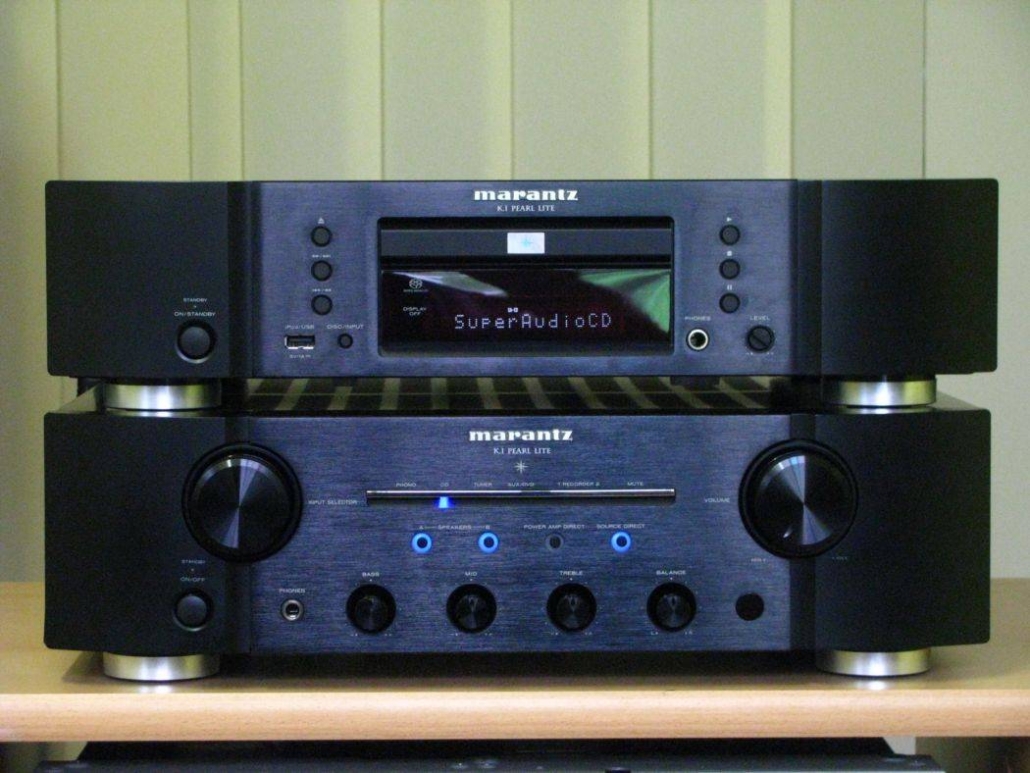
Marantz PM-KI Pearl Lite, Marantz SA-KI Pearl Lite
Owner’s Observations
Marantz KI-Pearl Lite SASERVIS EDITION
To start with, I should mention that 98% of the music I listen to is metal—truly heavy metal—
while the remaining 2% includes folk-rock, New Age, atmospheric and cinematic music, and classic rock.
One might ask why on earth I bought Marantz gear, given that the brand is known for a sound character that is rather slow, soft, and mid-range focused—
to some, simply pure “mud.”
The reason is simple… with all those so-called “high-end” brands, the style of music I listen to sounded shrill, harsh, and disjointed—sometimes too bass-heavy, other times overly emphasized in the high frequencies.
After listening to some older Marantz models, I appreciated the control and the way they brought the music—which is often inherently “intense” or “pushed hard”—into a pleasant, listenable balance.
So, I settled on the Marantz KI Pearl amplifier, intended to be their flagship model.
Of course, that was a limited edition that was nearly impossible to find, so I opted for the available version: the PM-KI Pearl Lite.
Disappointment followed quickly… only traces remained of that pleasant sound I had heard in the older models… the amplifier simply “couldn’t” pair properly with any audio source I tried…
Okay… so I bought the Marantz SA-KI Pearl Lite CD player.
It finally started to sound good, but aside from lacking “guts,” it also missed all those “nuances” that… …terms used to describe sound characteristics such as soundstage, clarity, precise and fast bass, and smoother highs…
I tried to solve the issue using the only option available to me—and the one most “audiophiles” turn to: I started mixing and matching cables—power cords, interconnects… eventually reaching a point where I owned power cables costing €700 apiece, yet I couldn’t take it any further.
There were some improvements, and it certainly helped in some areas.
But I still wasn’t even halfway there, so I reached out to SASERVIS and Mr. Janečka. Naturally, I had read all the reviews of his work; I initiated contact via email and phone and—albeit skeptically—began to “believe” in a miracle.
Right from the initial interaction, of course, you realize he isn’t going to feed you unrealistic nonsense; he keeps things grounded.
So, I first entrusted him with the amplifier, and two months later, I went to hear the result. Naturally, the changes were significant; the entire performance moved up a class.
The bass was precise and tight, and those “drugged-out” mids had partly vanished; the overall sound felt deeper and more accurate. However, it also struck me as a bit strident and somewhat restless.
The next step was supposed to be modifying the CD player.
As it happened, the amplifier ended up back with Mr. Janečka, marking the start of “Stage Two”—modifying both units together—which fortunately proved to be the right move.
After consulting with him, I decided to pursue the overhaul without compromise and extract the absolute maximum performance. I accepted that the original sonic signatures of both the amplifier and the Marantz would disappear, and that Mr. Janečka would incorporate his own vision of the ideal sound into the work.
After discussing the music I listen to, he understood exactly what I wanted to hear—and what I didn’t.
I can only imagine what went on during the process; while we maintained standard communication and Mr. Janečka kept me updated on the general changes, none of it really meant much to me at the time.
Stage Two took four months—which might seem like a long time—but the result speaks for itself:
The Marantz character is gone for good; perhaps the only thing that remains is a sense of composure and pleasantness, though this is largely because the amplifier now has everything firmly under control. Restlessness and nervousness vanish, and the sound—well, it is immense, truly powerful; it is hard to believe it’s coming from an amplifier with an output of 2x100W.
The bass hits like a strike on an anvil; the highs are rich in timbre—not overpowering, yet lively.
The mids are exquisitely defined; not the slightest detail or vocal decay is lost.
And then there is something that defies conventional understanding—something I haven’t heard in any system, even premium setups costing 10,000 euros: speed and dynamics. It is the fastest sound I have ever heard—make no mistake—metal and rock are unleashed, completely unbridled.
It often seems to me that the vocalist struggles to keep pace with the musicians.
There is only one downside to all this: I can ditch all those expensive cables.
Any change to the input—even just swapping a power cable whose characteristics and construction boost the intensity of certain frequencies—can disrupt the overall sonic harmony and completely kill the emotion and tonal richness of the voice, turning what I previously perceived as positive into a negative.
This means just one thing: stop the endless, senseless experimenting with cable swaps to compensate for issues that were already resolved through proper design and intent. Instead, turn to Mr. Janečka and get to the root of the problem—right where it actually originates: inside the equipment itself.
You will certainly be surprised.
I can highly recommend Mr. Janečka’s professional approach, technical expertise, and the modifications he performs.
A truly “tuned” machine will deliver a balanced performance effortlessly—even with 3-euro cables, as is the case with my setup now. That said, using a shielded power cable with thicker conductors and higher-purity metal for your amplifier can still bring out “nuances” like more powerful bass, if that’s your preference.
I therefore warmly recommend SASERVIS products; their quality meets the real-world needs of us customers (even those of us with a severe “audiophile” obsession).
Of course, my journey doesn’t end there; I’ve entrusted him with another piece of equipment, and I’m looking forward to the result.
DJ Mola
… Personally, I was quite unpleasantly surprised by the sound of this Marantz.
For such a high-end model, I expected a “normal,” natural sound with all the qualities that entails.
The whole thing felt soulless and jumbled together.
It lacked dynamics and resolution.
After several months of modifications, however, it was an absolute knockout!
As a fan of electronic music, I immediately noticed a marked improvement in dynamics. The amplifier—along with the CD player—finally came alive.
Everything is clean and highly detailed across every frequency range.
The soundstage also improved tremendously.
Maťo breathed soul into it.
Great work once again!
R.K.
…Before modification.
The first thing that struck me was the prominent midrange—in some recordings, it was actually too large and forward. Certain passages, especially in acoustic music, sounded unnaturally boosted, while others were suppressed; this applied to other genres as well.
As for the bass—it was there, but weak. It had a sort of “huuu” character. The sub-bass was barely audible, and the upper bass lacked definition and contour—it was simply muddy and, furthermore, overshadowed by the midrange.
The highs offered a pleasant but indistinct tinkling throughout the tracks, getting lost amidst that massive, beautiful midrange that always dominated the sound.
Instrument bodies varied wildly—some unnaturally large, others tiny. It certainly isn’t suited for classical orchestral music.
Regarding the soundstage—honestly, I expected more from Marantz… let’s just say it was acceptable, but only for a lower price bracket.
Spatial imaging—particularly the front-to-back depth—was very poor and vague. Forget about hearing subtle instrument decays or room ambience.
The overall sound character was soft and lackluster—or perhaps a failed attempt at imitating a tube amplifier.
…After the modification.
First listen… Wow, a larger soundstage where I can quite precisely pinpoint individual instruments. Subtle instrument decays are clearly audible.
Front-to-back localization offers a new dimension for the listener—something this setup didn’t deliver before.
The bass extends nicely from the bottom end; it is fast, full, well-defined, and punchy, yet it doesn’t overpower the rest. (Personally, I’d like even more definition, but then it wouldn’t be as full-bodied… a trade-off…)
The mids have finally settled down and no longer drown out everything else. The signature Marantz character remains—meaning they are slightly softer, but well within reasonable and tasteful limits. Overall, they are very fast and detailed.
The highs sound smoother; subjectively, there seems to be less of them (they don’t have to fight the mids for attention), and they are beautifully distributed across the soundstage.
The entire audio spectrum has audibly cleared up and quickened. The sound is livelier—it has simply come to life. It’s no longer that old setup with the muddy sound that couldn’t tell the difference between an MP3 and a CD. Now, the distinction is immediately apparent.
The sonic improvement in this setup—before versus after the modification—is truly significant. SASERVIS played an undeniable role in this upgrade, though credit is also due to the manufacturer for bringing their sound philosophy (and, above all, their quality?) to the world. Perhaps I’ve just fallen behind the times and the whole world has long since switched to MP3s… in that case, don’t bother modifying anything and just stick with the original setup.

