
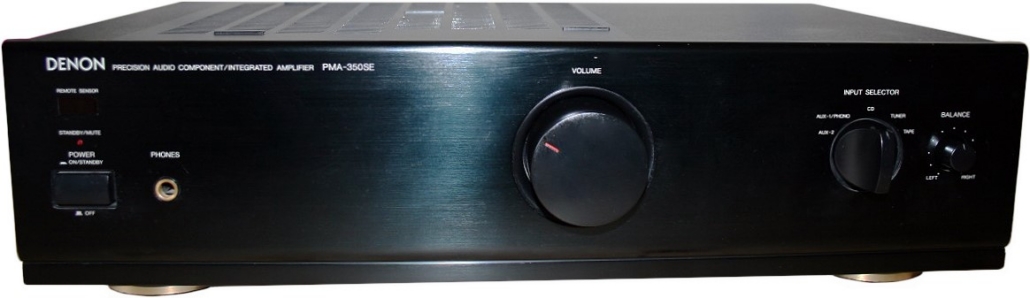
DENON PMA 350SE
Sound Performance /Owner’s Observations/
After Mr. Janečka completed the modifications, I eagerly connected the amplifier to my system, waiting to see how the improvements would manifest and whether I would actually be able to hear them. I was all the more surprised when I played the first disc—featuring music I knew intimately. From the very first listen, it felt as though I was hearing a brand-new amplifier belonging to a higher class of audio equipment.
Most importantly for me, the music began to breathe; each instrument took on its own dynamic character while remaining clearly defined and spatially distinct. A wealth of new detail emerged—nuances I hadn’t even realized were in the recording—yet the overall presentation remained cohesive, effortless, and natural. I don’t want to dissect specific frequency ranges here; simply put, musicians were suddenly playing in my living room, and the listening experience was more enjoyable than ever before. Another crucial aspect for me was the change in the bass response. Only now did I truly understand how a kick drum should sound—capturing its dynamics and the tactile impact of the beater hitting the drumhead—all without the muddy, boomy resonance that had previously bothered me so much. I believe that, considering the cost of the modification, I have never made a better investment in the world of hi-fi; all I can say is a huge “thank you.”
Audio Performance /SASERVIS/
Following the upgrade, the amplifier delivers a highly balanced and precise sound, accompanied by an excellent sense of spatiality—particularly regarding front-to-back depth. There is no muddiness; in symphonic music, instruments maintain stable, precisely defined positions that remain constant regardless of volume adjustments. Low frequencies are accurate and tight, with a volume level that is perfectly balanced against the rest of the spectrum. The overall level of detail is non-fatiguing; it does not attempt to impress at first listen with artificial or exaggerated elements. Instead, subtle nuances integrate naturally into the music, flowing clearly without harshness in the high frequencies or listener fatigue during extended sessions. The midrange is rich in timbre, lively, and well-resolved. Ample dynamic headroom is evident; even at high volumes, the amplifier retains its cohesion, resolution, and composure.
Independent Observation
In its class and price range, this amplifier was an interesting choice, capable of delivering a relatively neutral sound. However, the soundstage was flat and spatial imaging was weak—typical for this price category. The bass was somewhat boomy, and in other respects, it didn’t rise above the standard.
After modifications, I found the following:
1. The sound became more composed but, above all, more precise across the entire spectrum; it is now a pleasure to listen to.
2. There is a sense of slightly reduced treble, yet it is clean and highly precise. You can clearly hear the drumstick striking the cymbal followed by the cymbal’s subsequent resonance. I don’t perceive it as a mere “tink” or hiss; rather, the sound is well-distributed across the soundstage.
3. The bass is precise and well-defined.
4. Soundstage depth—it is simply vast, and imaging is nearly perfect.
5. Resolution has improved, bringing out more detail and precision. Only now do recordings truly sort themselves into “high-quality” and “sloppily produced” categories. Forget recordings with unnatural effects; while they might be impressive at first listen, you eventually realize they are literally unpleasant—even intrusive. That is precisely what doesn’t work for this amplifier (or the listener’s taste), because the unit simply amplifies exactly what you feed it… including a botched recording. There is no point discussing which genres suit it best. It handles whatever you feed it with ease—and despite having only 60W of power, it drives my Dynaudios effortlessly. This involves the modification of a 14-year-old amplifier, and the result was a decidedly pleasant surprise. In terms of sound, it was nothing short of shocking. Everything sounds different than it did before the modification, representing a massive leap forward in quality.

