
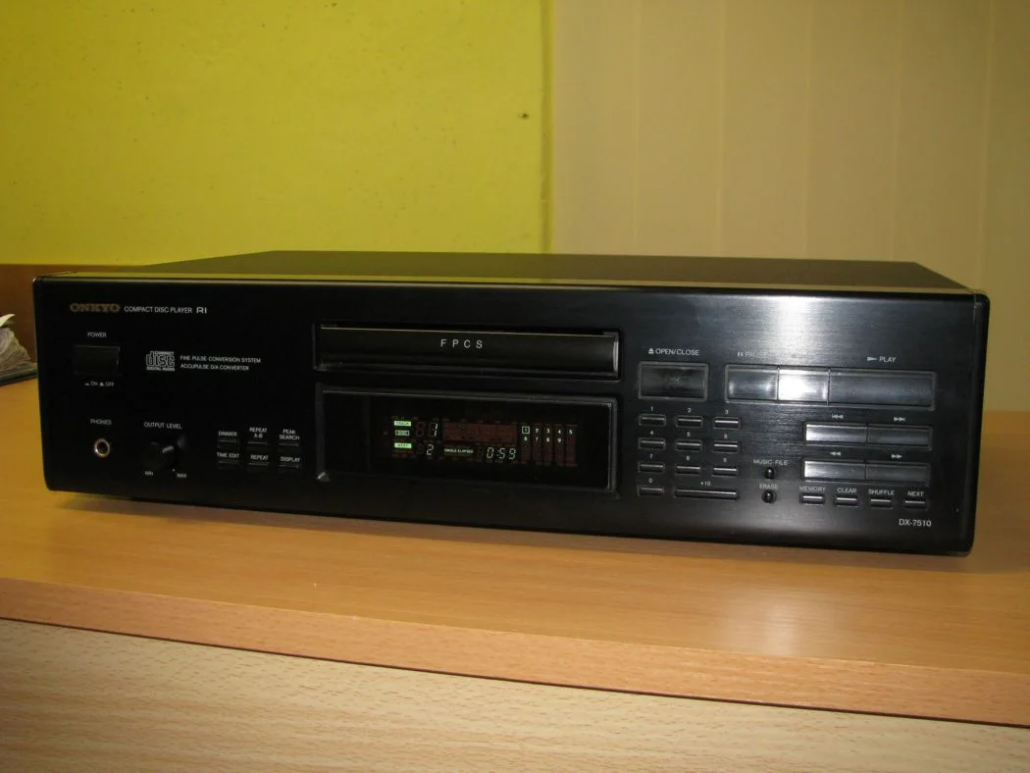
Onkyo DX-7510
Owner’s Observations
After quite some time, I decided to invest in my audio system.
It seemed pointless to buy new components when the old ones were still doing the job.
Subconsciously, I sensed there was more potential to be unlocked from my old Onkyo unit. So, I took up Mr. Janeček’s offer to upgrade my ONKYO DX 7510 CD player.
I entrusted it to his care for about a month, and now I am listening to the result.
It might be nice to start by introducing the complete system that has been bringing me joy for nearly 18 years.
The entire setup is from ONKYO, dating back to the 1996 model year—specifically the CD 7510 and the 9510 amplifier (which has undergone significant modification), along with a tuner and tape deck from the same brand, though the latter two currently serve only as background audio.
For just as long, I have been using speakers from the Czech brand XAVIAN (model XN 230), connected via a home-made “cross-4” configuration using standard 4mm CYKY cable in a bi-wiring setup.
A silver-plated copper cable from Cambridge Audio serves as the interconnect.
What matters most to me is the change in sound—the character of the music. Upon first listen, the silence between tracks is particularly striking. There is no hiss or noise—just a completely silent background.
I put in the first CD—*Divné století* by my favorite artist, Nohavica. Songs I’d heard a hundred times suddenly sounded different. It wasn’t anything earth-shattering; nothing jumped out at me—you could even say it was a bit of a letdown.
For that kind of money, one would expect more dramatic changes.
But that feeling lasted only a moment; suddenly, I heard things that had previously remained hidden.
Somewhere in the background—sounds and instruments I’d only sensed before, or knew existed from live concerts—were suddenly right there.
Subtle reverberations and musical lines I’d barely noticed until now came to the fore and were clearly audible.
The singer suddenly seemed a meter closer; the violins at the back left were distinctly audible. The oboe had a genuine woody timbre.
To exaggerate slightly, everything sounded so natural—exactly as if the band were right there in my listening room.
And then the album-swapping marathon began.
I listened to everything: rock, jazz, classical, folk… both old and new CDs.
I even revisited albums that hadn’t grabbed me before.
Suddenly, I found myself listening to them all the way through. In fact, I started seeking out those CDs from the corners of my collection because they had suddenly become enjoyable to listen to.
Of course, the recording quality matters a great deal; the truly high-quality ones sound excellent, but now, I don’t really have any that sound outright bad. The human voice has arguably seen the most improvement; I regret not having more tracks featuring this kind of music.
Duets and trios are beautifully distinguished within the soundstage, and with choral arrangements, you can hear practically every individual choir member.
Next in line are the improvements to the bass. It reaches deeper and is beautifully rendered and precisely defined.
I have already mentioned the silence during pauses and the electronic noise floor.
The one thing I would welcome even more of is the sense of space. There has been improvement here too, but one always wants more. Then again, that could be down to room acoustics, cable suitability, the amplifier, or the speakers.
At least I still have something to tinker with, and it opens up possibilities for further exploration.
And that is the best part of this hobby.
At least for me.
But ultimately, the goal should be listening to music, not chasing technically perfect sound…
In closing, I can only express my thanks and recommend Mr. Janečka’s services.

